Full-Length Practice Test 1 — Gemmy Somboontham
Comprehensive score breakdown with Adaptive Module 2 routing details and step-by-step question explanations.
Module 1: 0 / 27 correct (Hard Route threshold: ≥ 18) → Routed to Module 2: EASY ROUTE • Module 2: 0 / 27 correct
Module 1: 0 / 22 correct (Hard Route threshold: ≥ 14) → Routed to Module 2: EASY ROUTE • Module 2: 0 / 22 correct
Knowledge & Skills Domain Breakdown
| Section & Content Domain | Correct / Total | Accuracy (%) |
|---|---|---|
| English — Craft and Structure | 0 / 7 | 0% |
| English — Information and Ideas | 0 / 7 | 0% |
| English — Standard English Conventions | 0 / 7 | 0% |
| English — Expression of Ideas | 0 / 6 | 0% |
Question-by-Question Solution Review
Mangrove forests play a crucial role in stabilizing tropical shorelines, but their young seedlings are exceptionally ______ to variations in soil salinity during the initial germination phase. If salt concentrations rise even slightly beyond normal levels, the young plants fail to take root and quickly wither.
Choice B is the correct answer because 'sensitive' means easily affected or damaged by external conditions. The passage explains that even slight changes in salt concentrations can cause the young plants to fail to take root and wither, indicating that they are highly sensitive to soil salinity. Choice A ('resilient') is incorrect because it means able to withstand or recover quickly from difficult conditions, which contradicts the seedlings' failure to survive small salinity shifts. Choice C ('indifferent') means unresponsive or unaffected, which is the opposite of how the seedlings react. Choice D ('invisible') is irrelevant to how plants respond to environmental conditions.
The following text is adapted from an 1898 account of an Arctic expedition.
The final march across the frozen strait, though relatively short in miles, demanded immense physical fortitude. The harsh polar environment seemed determined to place every conceivable barrier across the explorers' path, confronting them with sudden blizzards, treacherous ridges of jagged ice, and temperatures plunging far below freezing.
In this context, "conceivable" means capable of being imagined or mentally grasped. The author emphasizes the extreme difficulty of the trek by suggesting that every possible or imaginable obstacle—from blizzards to jagged ice—appeared to hinder the explorers. Therefore, "imaginable" is the best answer. "Visible" (able to be seen), "definite" (certain or clear), and "convenient" (easy or advantageous) do not match the intended meaning of something that can be imagined or anticipated.
Atmospheric scientist Nadia Vance and her research group determined that rapid barometric pressure drops offer a reliable precursor to the formation of microbursts—intense, localized downdrafts that can severely destabilize low-flying aircraft. Prior to the onset of the downburst, Doppler radar arrays consistently register sharp shifts in low-altitude wind velocity above the target zone, providing crucial evidence that a turbulent event is _______.
Choice C is correct because "imminent" means about to happen or fast-approaching. The passage explains that radar shifts and pressure changes act as "a reliable precursor" that occurs "Prior to the onset" of the downburst, indicating that the turbulent event is about to take place. Choice A is incorrect because "negligible" means so small or unimportant as to be disregarded, contradicting the severe hazard posed by microbursts. Choice B is incorrect because "retrospective" relates to looking back at past occurrences rather than anticipating upcoming ones. Choice D is incorrect because "perpetual" means everlasting or continuous, whereas microbursts are acute, discrete occurrences.
The Maritime Heritage Trust recently collaborated with nautical archaeologist Dr. Elena Rostova to document sunken 18th-century merchant vessels in the Baltic Sea. The Trust's involvement proved ______ to the initiative: its specialists not only provided advanced sonar mapping systems but also secured the governmental maritime permits required to conduct deep-water surveys.
Choice B is the correct answer because 'integral' means essential or fundamental to the completeness of something. The text after the colon explains that the Trust provided crucial sonar systems and secured necessary permits, demonstrating that its involvement was vital to the initiative. Choices A ('peripheral'), C ('tentative'), and D ('redundant') contradict the context, which emphasizes the indispensable nature of the Trust's contributions.
In the bustling coastal community of Port Sterling, Captain Silas Montgomery was regarded by merchants and sailors alike as a model of steady judgment and professional integrity. At the maritime exchange, his presence reliably calmed contentious negotiations, and the sailors under his charge held him in high esteem for his fairness and composure. Montgomery never delivered a reprimand in anger; he framed corrections as practical counsel rather than harsh rebukes, took care to conceal any passing irritation during difficult voyages, and conducted all business dealings with such consistency that none of his peers ever found reason to question his character.
Choice B is the correct answer because the text opens by describing the widespread admiration and respect that Captain Montgomery enjoys among merchants and crew members in Port Sterling, and then proceeds to enumerate the habitual practices and disciplined behaviors—such as remaining calm, offering gentle guidance, and acting scrupulously—that enable him to maintain this esteemed reputation. Choice A is incorrect because the passage focuses on Montgomery's character and interpersonal behavior, not his wealth or financial investments. Choice C is incorrect because the text does not suggest Montgomery experiences severe inner turmoil or analyze his deeper psychological motives; it merely notes his self-control. Choice D is incorrect because the passage depicts Montgomery's positive standing as ongoing and active, rather than recounting a loss or decline of respect.
In several northern European nations, agricultural laborers historically integrated into broad, overarching industrial trade unions to negotiate collective bargaining protections and wage guarantees within existing legal frameworks. Conversely, farmworkers in parts of southern Europe chose to establish autonomous, agrarian-specific labor organizations focused strictly on the distinct seasonal rhythms and land-tenure challenges of rural work. This distinct strategy proved particularly influential in regions like Andalusia, where independent syndicates successfully mobilized thousands of day laborers without affiliating with the country's dominant urban labor confederations.
Choice B is correct because the passage presents two contrasting methods by which agricultural workers sought representation and workplace protections: one group incorporated into broad, pre-existing industrial trade unions (northern Europe), while another formed independent, specialized agrarian organizations (southern Europe, specifically Andalusia). Choice A is incorrect because the author remains descriptive and neutral rather than arguing that one method is superior. Choice C is incorrect because the passage does not trace a historical evolution over time from one region to another; it compares two separate contemporary models. Choice D is incorrect because the text does not discuss any influence that rural syndicates had on urban federations.
Text 1
When Igor Stravinsky's modernist ballet The Rite of Spring premiered in Paris in 1913, the audience was reportedly so shocked by its dissonant score and unconventional choreography that a violent riot erupted in the auditorium, with attendees trading blows and hurling objects. This chaotic evening marks a pivotal rupture in cultural history: traditional aesthetic sensibilities were shattered in a single night, and Western concert music was fundamentally redefined.
Text 2
Although music historians often repeat the dramatic tale of the 1913 premiere of The Rite of Spring, police reports and diary entries from that evening indicate that the disorder was limited to polite murmurs and scattered jeering, with no recorded brawls or property damage. Nevertheless, the riot narrative remains widely embraced. The persistence of this legend is instructive: our conviction that modernism arrived as a sudden, earth-shaking shock is so entrenched that we continually perpetuate an origin myth that cleanly divides artistic history into the traditional past and the revolutionary present.
Text 1 presents the traditional narrative that the premiere of The Rite of Spring sparked a violent riot that shattered conventional aesthetics and initiated musical modernism. In Text 2, the author notes that primary historical evidence (police reports and diary entries) disproves this story of a riot, arguing that the legend endures because society wants to believe modernism arrived as an abrupt, epoch-defining break. Therefore, the author of Text 2 would agree that Text 1's dramatic depiction reflects assumptions about modernism's revolutionary impact rather than documented historical facts.
Aromas and scents played a fundamental role in antiquity, frequently featuring in sacred ceremonies, medicinal therapies, and civic celebrations. For many decades, historians struggled to study these historical odors because the botanical materials that produced them deteriorate rapidly over time. Recently, however, advances in organic residue chemistry have enabled scientists to detect microscopic traces of resins and oils preserved within ancient earthenware vessels. By identifying and recreating these long-lost mixtures, scholars hope to gain a deeper understanding of the daily customs and commercial trade routes of past societies.
Choice B is correct because the passage explicitly states that by recreating these ancient formulas, scholars hope to 'gain a deeper understanding of the daily customs and commercial trade routes of past societies.' Choices A, C, and D mention concepts—such as commercial markets, container comparisons, or testing treatments against modern diseases—that are neither stated nor implied in the passage.
The following text is adapted from a fictional memoir set in nineteenth-century Britain. The narrator reflects on his years working as an assistant to a celebrated cartographer.
I may possess few remarkable gifts of my own, and my family often chided me for my aimless nature in those early years before I entered the survey office. Yet whatever my personal inadequacies, I had the extraordinary fortune to work alongside Master Alistair Vance, a man who possessed a singular, brilliant instinct for charting the coastline. For nearly a decade, I remained at his side, watching in awe as a faint notion would suddenly take root in his thoughts and flourish into intricate, masterful charts. To have witnessed such ingenuity firsthand remains the supreme privilege of my life.
Choice A is correct because the passage primarily focuses on the narrator looking back with profound appreciation at the years spent working alongside Master Vance, whom the narrator admires as a genius. Choice B is incorrect because the text does not state that Vance hid his talents. Choice C is incorrect because the narrator mentions his family only in passing to emphasize his own humble beginnings, not as a primary motivation. Choice D is incorrect because the focus is not on the general duration of cartographic projects, but rather on the narrator's admiration for his mentor's creative genius.
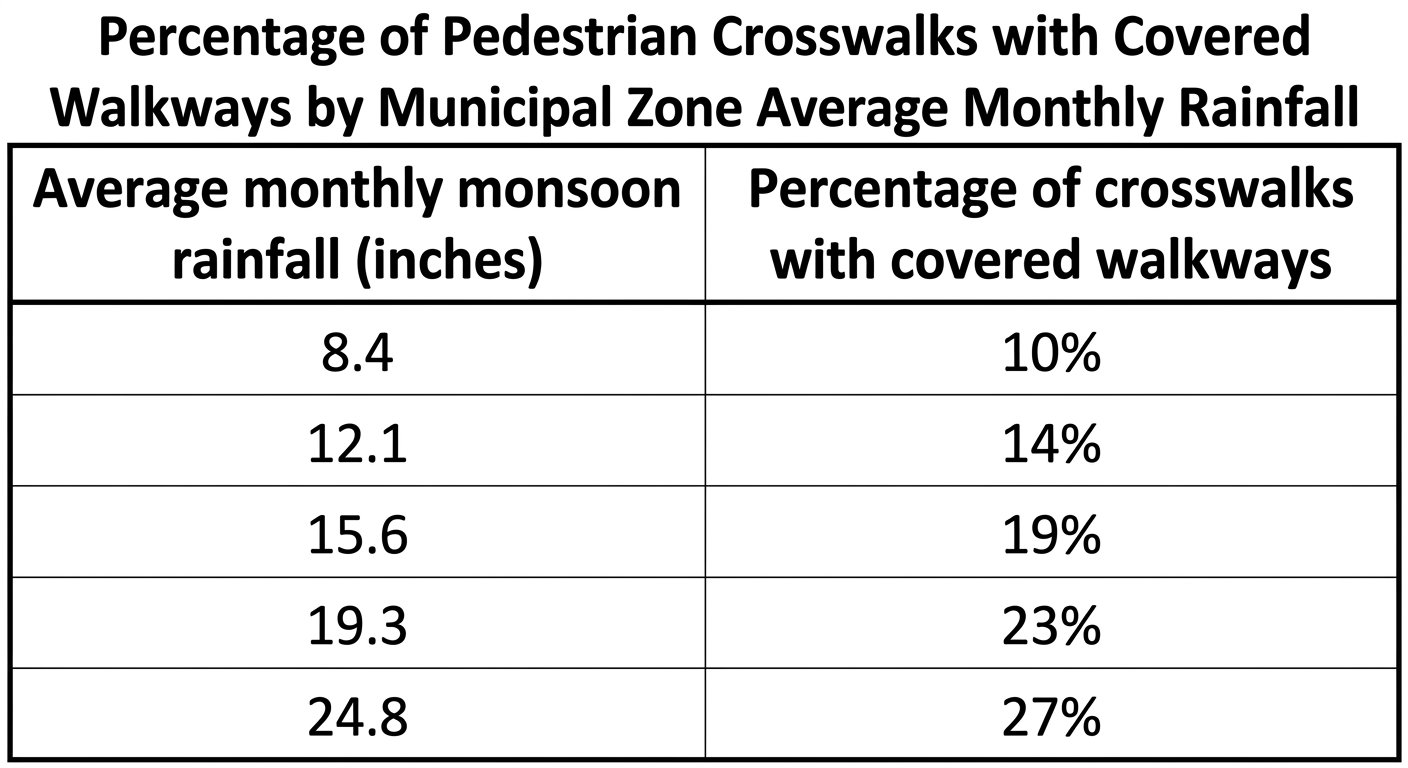
A civil engineer is assessing pedestrian infrastructure in a tropical municipality where seasonal rainfall varies by zone but is consistently high. The engineer argues that covered pedestrian walkways are underprovided throughout the municipality, noting that the highest percentage of pedestrian crosswalks with covered walkways in any zone is only _______
Choice B is correct because the table shows that across the five zones, the highest percentage of crosswalks with covered walkways is 27% (in the zone with 24.8 inches of average monthly rainfall). Filling the blank with 27% accurately completes the claim that the highest percentage in any zone is only 27%.
| Common name | Scientific name | Approximate time of local extirpation |
|---|---|---|
| Morro valley fern | Polystichum montanum | 1890 CE |
| Canyon clover | Trifolium saxatile | 1912 CE |
| Highland gentian | Gentiana alata | 1948 CE |
| Silverleaf pine | Pinus argentea | 9,000 years before present |
| Alpine spikenard | Aralia alpina | 4,500 years before present |
Conservation biologists attempting to reintroduce locally extirpated flora to an alpine plateau face significant environmental obstacles. In particular, researchers point out that the greater the duration since a plant taxon disappeared from an ecosystem, the more likely it is that mycorrhizal fungal networks and native pollinator communities have altered so substantially that the habitat can no longer sustain it. Among the plant species evaluated for reintroduction, this ecological shift would pose the greatest concern for the ______
Choice B is correct because the passage notes that habitat incompatibility due to ecological shifts is most pronounced the longer a taxon has been extirpated. According to the table, the silverleaf pine (Pinus argentea) has been extirpated the longest (9,000 years before present), making it the species for which this problem would be of greatest concern. Choice A and Choice D identify plants that disappeared relatively recently (in the twentieth century). Choice C is incorrect because it misinterprets the chronological data: the alpine spikenard disappeared 4,500 years before present, which is thousands of years after the silverleaf pine, not before.
Ecologist Elena Rostova and colleagues investigated how elevated atmospheric carbon dioxide (CO₂) influences the annual biomass accumulation of Scots pine saplings under shifting precipitation regimes. They measured sapling growth both with ambient CO₂ and with elevated CO₂ across three simulated conditions: baseline moisture, moderate drought, and severe drought. Although moisture deficits reduced overall tree productivity, Rostova's team concluded that elevated CO₂ could more than compensate for the negative impacts of water stress, provided that the drought is moderate rather than severe.
Choice A is correct because it directly demonstrates that elevated CO₂ can more than offset the adverse effects of moderate drought—since saplings under moderate drought with elevated CO₂ grew even more than saplings under normal baseline conditions with ambient CO₂—while also showing that elevated CO₂ cannot overcome severe drought, as baseline ambient growth remained higher than growth under severe drought even with elevated CO₂. Choices B, C, and D fail to show that elevated CO₂ fully compensated for moderate drought relative to baseline ambient conditions.
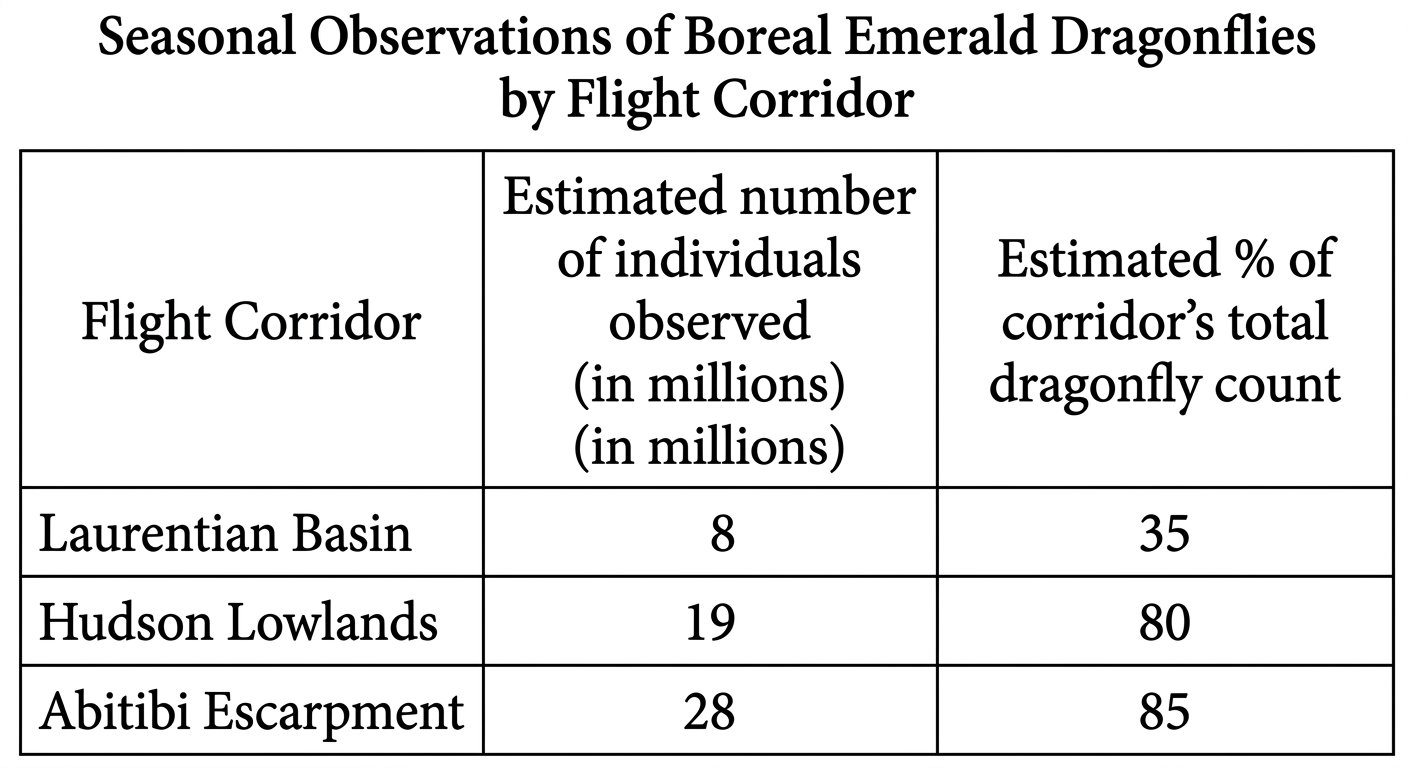
The boreal emerald dragonfly is estimated to have a total mature breeding population of at most 6 million individuals worldwide. Entomologists also monitor the species across three major seasonal flight corridors: the Laurentian Basin, the Hudson Lowlands, and the Abitibi Escarpment, where dense swarms are recorded annually during late-summer dispersal flights. Even in corridors where these dragonflies appear in enormous numbers, most of the observed individuals cannot be localized breeding residents of those habitats and are instead transient dispersers moving between broader geographical zones.
Choice A is correct because it directly supports the underlined claim by comparing the data in the table to the passage's stated global breeding population. The passage states that the species has a worldwide mature breeding population of at most 6 million individuals. The table shows that 28 million individuals are recorded in the Abitibi Escarpment alone during seasonal flights. Because 28 million is vastly greater than the entire worldwide breeding population of 6 million, the immense group observed in the Abitibi Escarpment cannot consist entirely of local breeding residents, thus providing direct evidence that the corridor is populated primarily by transient dispersers.
The brown marmorated stink bug (Halyomorpha halys) is an invasive agricultural pest in North America, where it feeds on fruit crops and inflicts severe financial losses on commercial orchards. While widespread application of synthetic insecticides can suppress H. halys numbers, this chemical intervention frequently eradicates beneficial native pollinators dwelling in the same habitats. Agricultural scientists are therefore developing species-specific RNA interference treatments that silence essential developmental genes exclusively in H. halys, consequently
The passage contrasts broad-spectrum insecticides—which control the invasive bug but also harm non-target native pollinators—with a newly developed genetic approach that functions 'exclusively in H. halys.' A logical continuation of this idea must highlight the primary advantage of this targeted approach: reducing the pest's numbers while leaving other organisms unharmed. Choice C directly aligns with this reasoning. Choices A, B, and D introduce unsupported effects regarding insecticide resistance, pollinator feeding behavior, or crop tolerance.
Conventional synthetic textiles like nylon rely heavily on petroleum-derived polymers, which generate substantial greenhouse gas emissions during production. Seeking a more sustainable alternative, materials scientist Aris Thorne utilized the bio-based ______ to engineer an eco-friendly fabric capable of matching the tensile strength of standard nylon.
Choice D is correct because 'lactic acid' is a restrictive appositive that specifies which particular bio-based monomer Thorne utilized. Because restrictive appositives provide essential identifying information, they should not be set off by commas. Additionally, no comma is needed between the noun phrase ('the bio-based monomer lactic acid') and the infinitive phrase ('to engineer...'). Therefore, no punctuation is required.
The Woods Hole Oceanographic Institution and the Scripps Institution of Oceanography are pioneering research centers committed to investigating fragile benthic ecosystems, ______ conducting long-term climate modeling; and deploying autonomous submersibles to survey deep-sea trenches.
Choice B is correct. In this sentence, the author presents a list of three parallel commitments: (1) investigating fragile benthic ecosystems, particularly hydrothermal vents and cold seeps; (2) conducting long-term climate modeling; and (3) deploying autonomous submersibles. Because the first item contains internal punctuation (a comma setting off the nonrestrictive phrase 'particularly hydrothermal vents and cold seeps'), semicolons must be used to separate the main items in the series. A semicolon is already used after the second item ('climate modeling;'), so a semicolon must also conclude the first item. Choice A is incorrect because using a comma creates faulty parallelism and confuses the list structure. Choice C is incorrect because it provides no punctuation to separate the first item from the second. Choice D is incorrect because it places a semicolon inappropriately after 'particularly' and ends the item with a comma instead of a semicolon.
A 2022 survey led by marine ecologist Anahi Morales documented the unexpected proliferation of cold-water coral _______ dense marine ecosystems that thrive in deep, sunless oceanic depths, providing essential shelter for hundreds of invertebrate and fish species.
Choice A is correct because a colon is used to connect an independent clause ("A 2022 survey... documented the unexpected proliferation of cold-water coral gardens") to an appositive noun phrase ("dense marine ecosystems...") that defines or elaborates on the noun immediately preceding it. Choice B is incorrect because omitting punctuation fuses two noun phrases without proper separation. Choice C is incorrect because a semicolon must separate two independent clauses, but the text following the punctuation lacks a main subject and finite verb. Choice D is incorrect because placing a period creates an incomplete sentence fragment.
In the traditional Scandinavian lawn game kubb, players toss wooden batons across a field to topple rectangular blocks; knocking over the centrally placed wooden king _______ victory for the attacking team.
Choice A is correct because the subject of the clause is the singular gerund phrase 'knocking over the centrally placed wooden king.' A singular subject takes a singular verb, so 'secures' is the correct form to match the simple present tense established earlier in the sentence ('toss'). Choices B, C, and D are incorrect because 'secure,' 'are securing,' and 'have secured' are plural verb forms.
Beatrix Farrand, a pioneering American landscape architect, ______ responsible for designing the celebrated formal gardens at Dumbarton Oaks in the early twentieth century.
The subject of the clause is 'Beatrix Farrand,' which is a singular proper noun. The phrase 'a pioneering American landscape architect' is an appositive modifying the subject and does not affect agreement. Therefore, the singular verb 'was' is required to agree with the singular subject. Choices A, B, and D are incorrect because 'were,' 'have been,' and 'are' are plural verbs.
Marine ecologist Elena Vance, of the Coastal Wildlife Institute in Washington, ______ the foraging behaviors of sea otters along the Pacific coastline—specifically, how food availability influences their territorial patterns and social groups.
Choice A is correct because the singular verb 'examines' properly agrees with the singular subject 'Marine ecologist Elena Vance'. The intervening prepositional phrase 'of the Coastal Wildlife Institute in Washington' does not alter the number of the subject. Choices B, C, and D are incorrect because 'are examining', 'have examined', and 'examine' are plural verb forms.
In 2018, urban planner Marcus Thorne directed the installation of dozens of permeable pavements—porous concrete surfaces engineered to absorb and filter precipitation—across the civic district of Leeds. By allowing rainwater to percolate directly into the underlying soil, ______
Choice B is correct because the introductory prepositional phrase 'By allowing rainwater to percolate directly into the underlying soil' is a modifying phrase that must logically describe the subject directly following the comma. The entity that allows rainwater to percolate into the soil is 'the pavements.' Choices A, C, and D improperly place other nouns ('the reduction,' 'both localized surface flooding,' and 'the pavements' alleviation') immediately after the modifier, resulting in dangling modifier errors.
To construct an intricate hanging nest, a male weaverbird begins by selecting a sturdy branch. First, he loops long strips of fresh grass around the twig to form a secure base. _______ he weaves a hollow sphere with a downward-facing entrance tunnel. Finally, he lines the interior with soft feathers and down before displaying the structure to prospective mates.
Choice B is correct because the passage presents a sequence of steps that a weaverbird follows chronologically: 'First,' 'Next,' and 'Finally.' Therefore, 'Next' provides the most logical transition to indicate the second step in the process. Choices A, C, and D are incorrect because they indicate an illustration, a contrast, and an emphasis, respectively, none of which reflect the chronological sequence described.
Cultivated meat—food grown directly from animal cells rather than through traditional animal husbandry—has frequently been heralded as an essential innovation for curbing global greenhouse gas emissions and preserving arable land. Agronomists and environmental scientists have long emphasized its potential to transform modern protein production without compromising animal welfare. _______ significant engineering bottlenecks and exorbitant bioreactor media expenses have historically kept cell-based agriculture from becoming economically viable at an industrial scale.
Choice B is the correct answer because the transition 'That said,' introduces a contrast or qualification to the preceding claim. The first two sentences highlight the immense promise and theoretical benefits of cultivated meat, while the final sentence introduces the practical limitations and obstacles that have historically impeded its viability. Choice A ('Consequently') is incorrect because it indicates a causal result rather than a contrast. Choice C ('Furthermore') is incorrect because it signals an addition of similar supporting points rather than a counterpoint. Choice D ('Specifically') is incorrect because it introduces elaboration or precise details of the previous claim rather than a contrasting obstacle.
While researching a topic, a student has taken the following notes:
• The standard QWERTY keyboard layout was introduced in the 1870s for mechanical typewriters.
• In the QWERTY layout, common letter pairs are scattered across different rows, requiring significant finger travel.
• The Dvorak keyboard layout was designed in the 1930s as an ergonomic alternative to the QWERTY layout.
• The Dvorak layout clusters the most frequently used letters on the central "home row."
• By substantially reducing finger movement, the Dvorak layout allows for faster typing speeds and reduced physical strain.
Choice B is correct because it directly addresses the student's goal of emphasizing an advantage of the Dvorak layout over the QWERTY layout: it explains that the Dvorak layout enables faster typing and reduces physical strain compared to the QWERTY layout. Choice A merely compares the dates the layouts were introduced. Choice C vaguely mentions solving problems without specifying the layout's advantages. Choice D mentions historical purpose rather than a functional advantage.
While researching a topic, a student has taken the following notes:
- Geologists classify metamorphic rock formation into distinct categories based on temperature, pressure, and tectonic setting.
- Regional metamorphism occurs across broad continental regions subjected to intense directed pressure, often producing foliated rocks like gneiss.
- Contact metamorphism occurs when preexisting rock comes into direct proximity with an underground magma intrusion, often producing non-foliated rocks like hornfels.
- Regional metamorphism is the large-scale alteration of rock driven primarily by tectonic forces and high pressure over vast areas.
- Contact metamorphism is the localized alteration of rock driven primarily by intense thermal energy radiating from nearby molten rock.
Choice A is correct because it directly and accurately defines contact metamorphism using the specific explanation provided in the notes. Choice B focuses on comparing rock types and scale rather than clearly defining what contact metamorphism is. Choice C defines regional metamorphism rather than contact metamorphism. Choice D offers a vague generalization about how geologists identify rock types without explaining contact metamorphism.
While researching a topic, a student has taken the following notes:
• The common name "tamarind" derives from the Arabic phrase tamr hindī, meaning "Indian date."
• Tamarind trees (Tamarindus indica) are leguminous trees native to tropical Africa.
• The common name "avocado" originates from the indigenous Nahuatl word āhuacatl.
• Avocado trees (Persea americana) are flowering trees native to the Americas.
Choice C is correct because it presents a generalization ("Common plant names frequently reflect diverse linguistic heritages") and supports that claim with relevant evidence from the notes (the Arabic root of "tamarind" and the Nahuatl root of "avocado"). Choice A compares the native regions of the two trees rather than their names. Choice B focuses only on tamarind and contrasts its common name with its scientific name. Choice D makes an unsupported statement about tree yield and fails to address the linguistic origins of the names.
While researching a topic, a student has taken the following notes:
• For over a century, natural philosophers debated whether light was composed of particles or waves.
• In 1704, English physicist Isaac Newton advocated the corpuscular theory, proposing that light consists of tiny material particles emitted by luminous objects.
• In 1678, Dutch polymath Christiaan Huygens proposed the wave theory, arguing that light travels through space as undulating pulses in a continuous medium.
• In 1801, English scientist Thomas Young conducted the double-slit experiment, producing interference patterns that offered decisive evidence for the wave model and largely quelled the dispute.
Choice B is correct because it effectively provides a historical overview of the debate between the two competing theories (corpuscular and wave) and explains how the conflict was ultimately resolved by Thomas Young's 1801 experiment. Choices A, C, and D are incorrect because each focuses on specific individuals or aspects of the timeline without presenting a comprehensive historical overview of both theories and the resolution of the debate.